
A protocol from Rajan Dental Institute, Chennai
Support where the back teeth are. Not where the bone is easy.
The ZyRAX protocol places zygomatic implants in the first or second molar region, so a full upper arch is carried to its last tooth. No bone grafting. No distal cantilever. Fixed teeth within 24 to 96 hours.

Published case series, 2 to 9 months follow-up. J Maxillofac Oral Surg, 2026.
The problem
When the upper jaw runs out of bone, most protocols run out of options.
All-on-4 and All-on-X depend on bone in the front of the upper jaw. When resorption is severe or the sinus has expanded, that bone isn’t there.
Zygomatic implants solve the anchorage problem by reaching into the cheekbone. In the usual techniques, though, they emerge near the second premolar. The bridge then has to hang backwards, unsupported, into the molar region. That overhang is a cantilever, and cantilever load is one of the known pressures on long-term full-arch success.
The common workarounds, a pterygoid implant, a second zygomatic implant on the same side or a quad-zygoma case, each add surgical difficulty of their own.
The ZyRAX answer
Move the support backwards, and the overhang disappears.
ZyRAX combines two decisions.
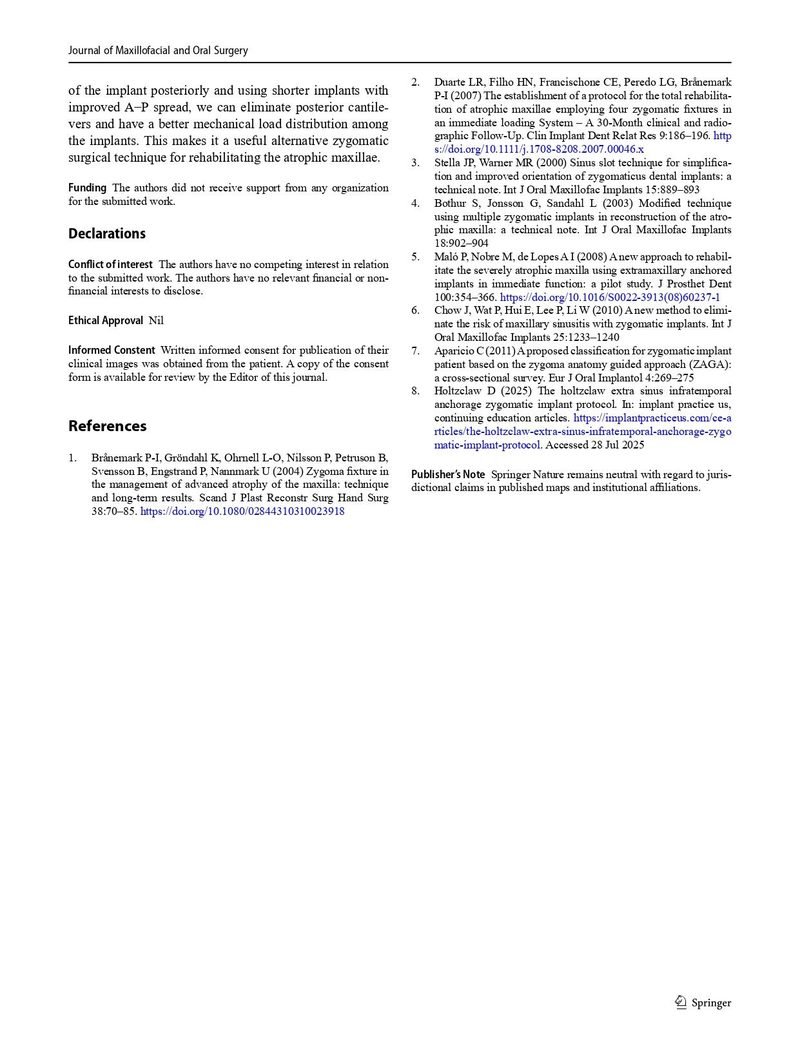
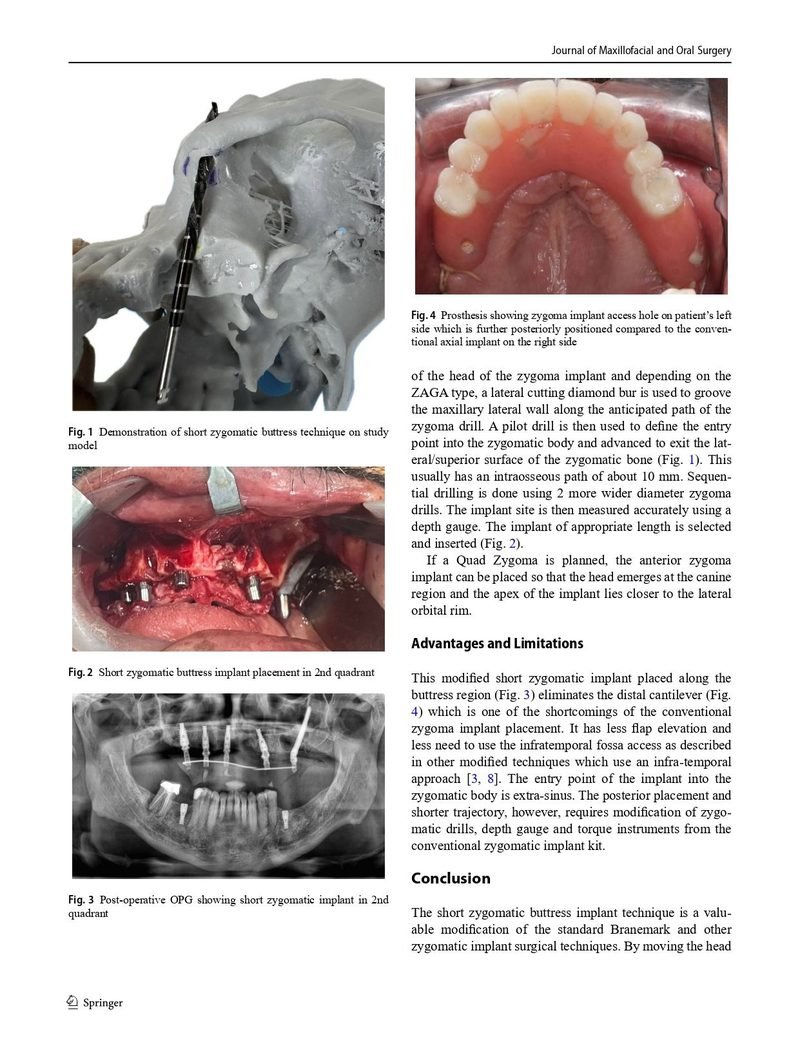
The implant runs a largely extra-sinus path, its apex engaging the body of the zygoma, and its platform emerges at or just buccal to the crest in the first or second molar region. The prosthesis is now supported at its back end instead of hanging past it.
In zones 1 and 2, implants are placed axially, tilted, trans-nasally, or palatally with nasal floor anchorage, chosen on the bone width actually present.
Together they can reduce the need for a pterygoid implant, a second zygomatic implant on the same side, or a quad-zygoma approach.
Evidence
Published, with its limits stated.
ZyRAX was described in the Journal of Maxillofacial and Oral Surgery in 2026, as a retrospective series of 15 consecutive patients. Twenty-six zygomatic implants reached enough primary stability for immediate full-arch provisionalisation. Complications were minor and resolved.
Follow-up so far runs 2 to 9 months, and larger multicentre studies are needed before the protocol can be called validated. The authors say exactly that in print.
The Protocol
The ZyRAX protocol
A full-arch approach for the severely atrophic maxilla that puts the posterior support point in the molar region and places the anterior implants on the bone that is actually there.

What the name holds
| Stands for | What it means in theatre | |
|---|---|---|
| ZyR | Zygoma, Rajan buttress technique | Zygomatic implant with its platform emerging at the first or second molar, on the crest or just buccal to it |
| AX | Anterior implants, All-on-X concept | Implants in Bedrossian zones 1 and 2, the approach chosen on available bone width |
ZyR
The buttress zygoma
The zygomatic buttress region is flattened, the implant takes a largely extra-sinus path, and its apex engages the body of the zygoma.
Lengths used in the published series ran 30–45 mm. The shortest zygomatic implant commercially available today is 30 mm, and the buttress technique sometimes calls for shorter: 26 or 28 mm.
Platform emergence sits in the molar region, which is what removes the distal cantilever rather than compensating for it.
AX
The anterior implants
The choice follows bone width in zones 1 and 2.
| Available bone width | Approach |
|---|---|
| ≥ 5 mm | Axial or tilted implants, with or without nasal cortical engagement |
| < 5 mm | Palatally placed implants, with or without nasal cortical engagement |
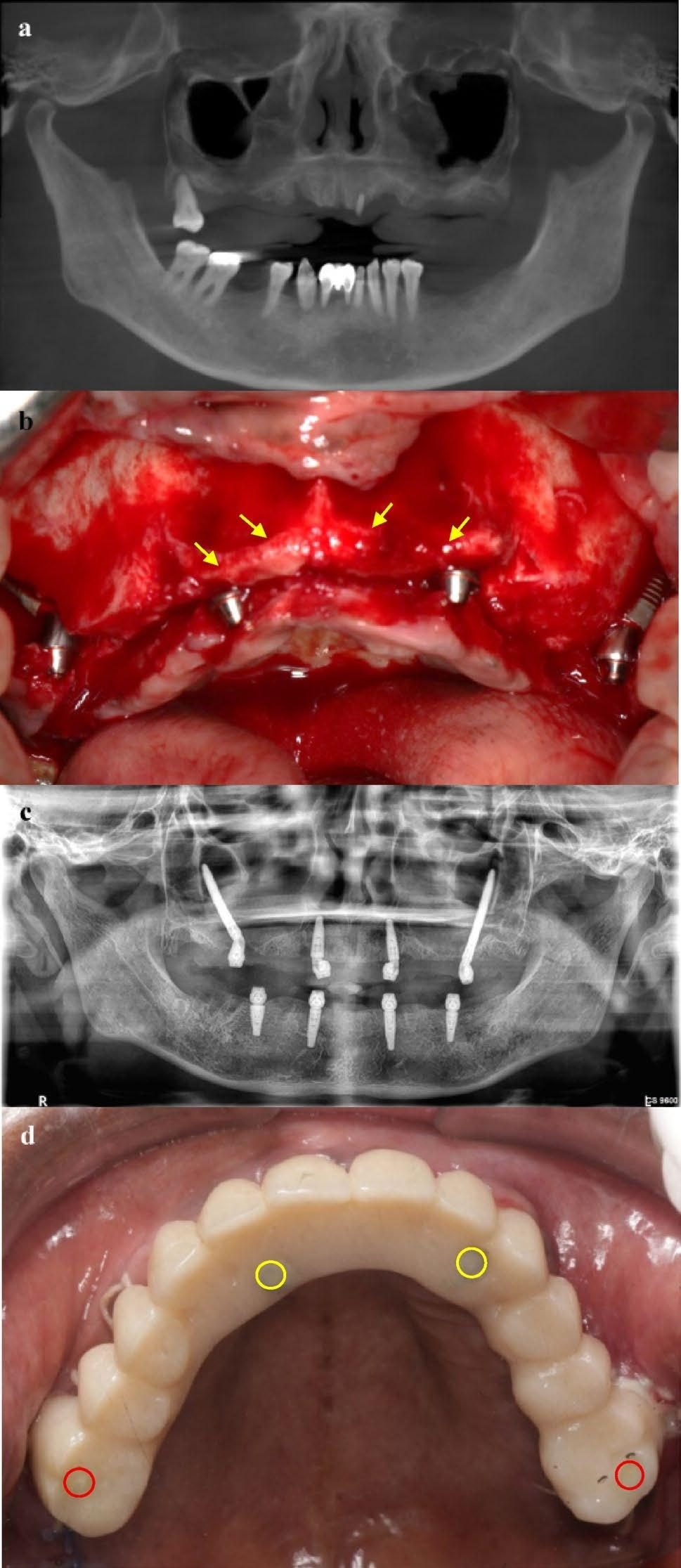
In the published series this produced 29 axial, 8 tilted, 2 trans-nasal and 6 palatally positioned implants with nasal floor anchorage. Palatally positioned implants have reported 98.38% success over five years in the literature, provided intact buccal bone remains, even 1 mm.
Immediate loading
Fixed teeth in 24 to 96 hours
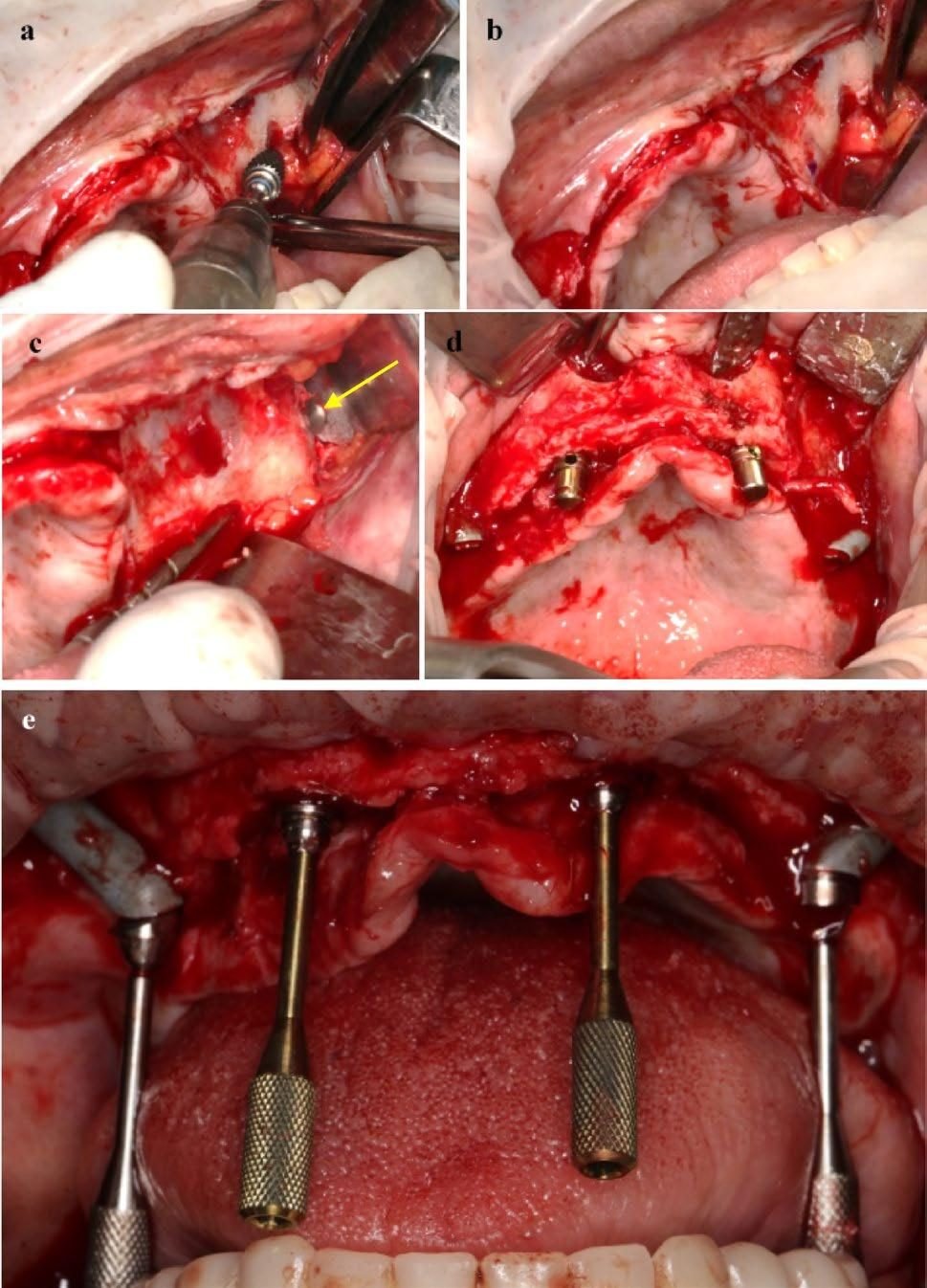
All patients received screw-retained PMMA full-arch bridges within 24 to 96 hours of surgery, some through conventional prosthetic steps, some as denture conversions.
Planning used prosthetic software to fix the multi-unit abutment and implant positions. A printed full-arch prosthesis was used to mark the platform position on bone against the central fossa of the first or second molar.
Context
How it sits against the alternatives
| Approach | Posterior emergence | Trade-off |
|---|---|---|
| Intra-sinus, extra-sinus, extended sinus zygoma | Second premolar, or premolar–molar junction | Leaves an unsupported distal extension |
| Pterygoid implant | Second or third molar | Technique-sensitive; reported inadequate primary stability for immediate provisionalisation in nearly 58% of full-arch situations |
| Fortin technique | Molar region, palatally placed | Intra-maxillary, palatal approach |
| HESIAn | Second or third molar | Infratemporal fossa approach, more extensive surgical exposure |
| ZyRAX | First or second molar, buccal to the crest | Cantilever removed with the zygoma itself, with anterior support from zones 1 and 2 |
Stated limitations of the technique
The buttress approach needs good mouth opening and interocclusal space. Standard zygoma drills run 55 to 75 mm, and with intact mandibular teeth or a fixed lower bridge the room to angle them posteriorly is reduced. Shorter drills would make the technique easier.
The Evidence
What the published series shows
Fifteen patients, 26 zygomatic implants, no implant or prosthetic failures recorded during a 2 to 9 month follow-up, and the authors’ own account of what that does and doesn’t prove.
The series
- Patients
- 15 (9 male, 6 female), aged 18 to 78
- Setting
- Rajan Dental Institute, Chennai, a tertiary care centre
- Design
- Retrospective case series
- Indication
- Severe maxillary atrophy requiring unilateral or bilateral zygomatic implants
- Pre-op records
- CBCT, intraoral scan and photographs for every patient
- Zygomatic implants
- 26, lengths 30 to 45 mm, all placed freehand by a single surgeon
- Anaesthesia
- General anaesthesia for all fixture placement
- Follow-up
- 2 to 9 months at publication
Outcomes
- All 26 zygomatic implants achieved primary stability adequate for immediate full-arch provisionalisation.
- Two implants, in two different patients, recorded under 30 Ncm. Both patients still received an immediate fixed provisional: a shortened arch running from the first molar on the opposite side to the premolar on the affected side.
- Screw-retained PMMA bridges were delivered within 24 to 96 hours.
- No implant or prosthetic failures were recorded during follow-up. No abutment screw loosening, prosthetic screw fracture or framework fracture. No soft tissue dehiscence or inflammatory sequelae.
Bone-to-implant contact at the zygoma
Mean contact length, mm. ZyRAX measured on post-op CBCT in 5 patients; comparison figures are published anatomical values.
Complications, in full
| Complication | Patients or sites | Management and outcome |
|---|---|---|
| Sinus membrane exposure | 2 implant sites | Managed with platelet-rich fibrin; no further intervention |
| Primary stability under 30 Ncm | 2 implants | Shortened-arch provisional instead of full arch |
| Post-operative ecchymosis | 3 patients | Resolved completely by day 14 |
| Infraorbital paraesthesia | None | No transient or permanent neurosensory deficit observed |
Figures from Rajan G et al., J Maxillofac Oral Surg, 2026.
What the authors say it does not yet show
- Sample size. Fifteen patients. Larger multicentre studies are needed to validate the protocol across a broader population.
- Follow-up. Two to nine months. The long-term success rate remains to be documented.
- Comorbidity. The cohort carried controlled diabetes, hypertension, hypothyroidism and ectodermal dysplasia, and it is not possible to say whether any one of these would change the outcome.
Follow-up plan
Clinical evaluation every six months for a minimum of three years, annual CBCT, long-term implant and prosthesis survival rates, and patient-reported outcome measures.
Citation
Rajan G, Haers PEJ, Surej Kumar LK, Dhamu H, Gopinath T. ZyRAX Protocol: A Novel Concept of Maxillary Full Arch Implant Rehabilitation Using the Buttress Zygoma Implant. Journal of Maxillofacial and Oral Surgery. Published online 24 March 2026. doi:10.1007/s12663-026-03011-x
Companion paper: Rajan G, Kumar LKS, Krishnamoorthy S, Samson J, Dhamu H, Gopinath T. Short Zygomatic Buttress Implants: A Technical Note. J Maxillofac Oral Surg. 2025. doi:10.1007/s12663-025-02793-w
For Patients
If you’ve been told there isn’t enough bone
ZyRAX is for people whose upper jaw has lost so much bone that ordinary implants have nowhere to go, and who would rather not spend a year on grafting first.
What is happening in your jaw
When upper teeth are lost, the bone that held them shrinks. The sinus above expands into the space left behind. Eventually the ridge is too thin and too shallow to hold an implant at all. Dentures loosen, the face shortens, and most clinics will offer you bone grafting and a long wait.
What ZyRAX does instead
The cheekbone, the zygoma, does not shrink. It stays solid whatever happens to the jaw. ZyRAX anchors long implants into the cheekbone and brings them out at the back of your upper jaw, where your molars used to be. Shorter implants go in at the front, placed in whatever bone is there. A fixed bridge is then screwed onto all of them.
The difference from other cheekbone techniques is where the support comes out. In most of them it ends near your premolars, and the bridge has to stick out behind it with nothing underneath. In ZyRAX the support reaches the molar region itself, so the bridge is held all the way to its back end.
Your treatment, step by step
Assessment
A CBCT scan, an intraoral scan, photographs, and a review of your medical history.
Planning
Your prosthesis is designed first, and implant positions are planned to suit it. A printed arch marks where each implant should sit.
Surgery
Implant placement under general anaesthesia.
Fixed teeth
A screw-retained bridge is fitted within 24 to 96 hours. You leave with fixed teeth, not a removable denture.
Follow-up
Reviews every six months, with a CBCT each year to monitor the implants.
You may be a candidate if
- You have severe upper jaw bone loss (Cawood–Howell Class V or VI) and have been assessed as needing a zygomatic implant
- You are in reasonable general health (ASA I or II)
- You have diabetes that is under control
- You can open your mouth comfortably wide; the instruments used are long, and access matters
ZyRAX is not suitable if
- You have an active maxillary sinus infection, or untreated disease of the cheekbone
- You have a systemic condition that is not under control
- You are a heavy smoker
- You have had radiotherapy to the head or neck
Where this stands
ZyRAX was published in 2026 as a series of 15 patients. No implant or prosthetic failures were recorded, but the patients have been followed for between two and nine months so far. Long-term results are still being collected, and your surgeon will discuss what is known and what is not before you decide anything.
For Clinicians
The protocol, the indications, and where to learn it
ZyRAX carries the same indication as any zygoma or pterygoid case. What changes is where the posterior support point sits, and what that removes from the prosthesis.
Case selection
Include
- Cawood–Howell Class V or VI, indicated for single or ipsilateral double zygoma
- ASA Physical Status I or II
- Controlled diabetics
Exclude
- Active maxillary sinusitis or untreated pathology of the zygomatic bone
- Uncontrolled systemic disease
- Heavy smoking
- History of radiotherapy to head and neck
The case for the biomechanics
Cantilever reduction is an established factor in long-term full-arch success. ZyRAX removes the distal cantilever at source by moving the zygomatic platform to the first or second molar, rather than compensating for it with a pterygoid implant.
Finite element work has shown zygomatic implants to withstand more force than pterygoid implants. Pterygoid implants also carry their own difficulties: technique sensitivity, risk of displacement into the infratemporal fossa, bleeding, and reported inadequate primary stability for immediate provisionalisation in nearly 58% of full-arch situations.
Combined with anterior implants in zones 1 and 2, the protocol also reduces the need for an ipsilateral second zygomatic implant, a more demanding procedure with more reported orbital complications.
Hands-on training
What the course covers
- Case selection and CBCT interpretation for the atrophic maxilla; Bedrossian zone assessment
- Prosthetically driven planning, multi-unit abutment positioning, and the printed-arch marking technique
- Buttress preparation, freehand zygoma placement, and managing drill length against interocclusal space
- Anterior options: axial, tilted, trans-nasal, palatal with nasal floor anchorage
- Immediate loading: conversion versus conventional prosthetic steps
- Complication management, including PRF for sinus membrane exposure
Refer a case
Send a CBCT and a brief history.
You will receive a written assessment of whether ZyRAX applies, usually within three working days.
About
Where the protocol comes from
ZyRAX was developed and published by the team at Rajan Dental Institute, Chennai, with co-authors in Hong Kong and at the Chennai Dental Research Foundation.

Lead author
Prof. Dr. Gunaseelan Rajan
MBBS, BDS, FDSRCS (England), PhD, DSc (Honoris Causa)
Oral and maxillofacial surgeon and Medical Director of Rajan Dental Institute. Corresponding author of the ZyRAX paper and of the preceding technical note describing short zygomatic buttress implants.
The author team
| Author | Affiliation |
|---|---|
| Gunaseelan Rajan | Rajan Dental Institute, Chennai |
| Piet E. J. Haers | Department of OMF Surgery, Hong Kong University, Hong Kong |
| L. K. Surej Kumar | Rajan Dental Institute, Chennai |
| Harshhan Dhamu | Rajan Dental Institute, Chennai |
| Tarunikaa Gopinath | Chennai Dental Research Foundation, Chennai |
The institute
Rajan Dental Institute in Mylapore, Chennai, is a tertiary care centre and the place where all 15 cases in the published series were treated. It runs 18 dental chairs, two operating theatres and an in-house laboratory, so planning, surgery and the immediate prosthesis happen under one roof.
Disclosures, as published
The authors received no support from any organisation for the submitted work and declared no competing interests. Informed consent was obtained from patients.
FAQ
Questions we’re asked most
For patients
Will I leave with fixed teeth?
In the published series, every patient received a screw-retained fixed bridge within 24 to 96 hours of surgery. Two patients received a shortened bridge at that stage because one implant recorded lower initial stability.
Do I need a bone graft first?
No. ZyRAX is a non-augmentative protocol. It works with the bone you have and anchors into the cheekbone, which does not resorb.
Is it done under general anaesthesia?
Yes. All fixture placements in the published series were performed under general anaesthesia.
What can go wrong?
In the published series: two sinus membrane exposures, managed with platelet-rich fibrin and needing no further intervention, and three patients with bruising that cleared by day 14. No numbness of the infraorbital nerve was seen, temporary or permanent. Your surgeon will go through the risks specific to your case.
How long will the implants last?
Nobody can tell you yet. Patients in the published series have been followed for two to nine months with no failures recorded. The team is following them for at least three years with annual CBCT. Zygomatic implants more broadly have decades of literature behind them; ZyRAX is a newer way of positioning them.
Am I too old?
Age alone is not a bar. The published series ran from 18 to 78 years. General health matters more than age.
For clinicians
How does this differ from the Rajan buttress zygoma technique?
The buttress technique is the zygoma placement. ZyRAX is the full-arch protocol that combines it with anterior implants in zones 1 and 2, placed on the All-on-X concept.
Does it eliminate the need for pterygoid implants?
It reduces it. With the posterior support point already at the first or second molar, the pterygoid implant’s main role, posterior anchorage without cantilever, is already served.
What length zygomatic implants are used?
30 to 45 mm in the published series. Some buttress cases call for implants shorter than the 30 mm minimum currently on the market, down to 26 or 28 mm.
What is the main technical constraint?
Interocclusal space and mouth opening. Standard zygoma drills are 55 to 75 mm; with intact mandibular teeth or a fixed lower bridge, achieving posterior angulation gets difficult. Shorter drills would ease this.
Can I observe or train?
Yes. Training is run at Rajan Dental Institute, Chennai. Register your interest through the clinician form and we’ll send you the next course dates.
Contact
Start with a scan.
Candidacy for ZyRAX is decided on a CBCT, a clinical examination and your medical history, not on a phone call.
We review every enquiry against the same criteria. If ZyRAX isn’t right for you, we’ll say so and tell you what is.
Refer a case, request the reprint, or register for the next course. Send a CBCT and a clinical summary for a written assessment.
Your details are ready to send
To reach the surgical team, email the summary below, with your scan attached, to info@rajandental.com, or call +91 95660 55855. A member of the team will reply within two working days.